

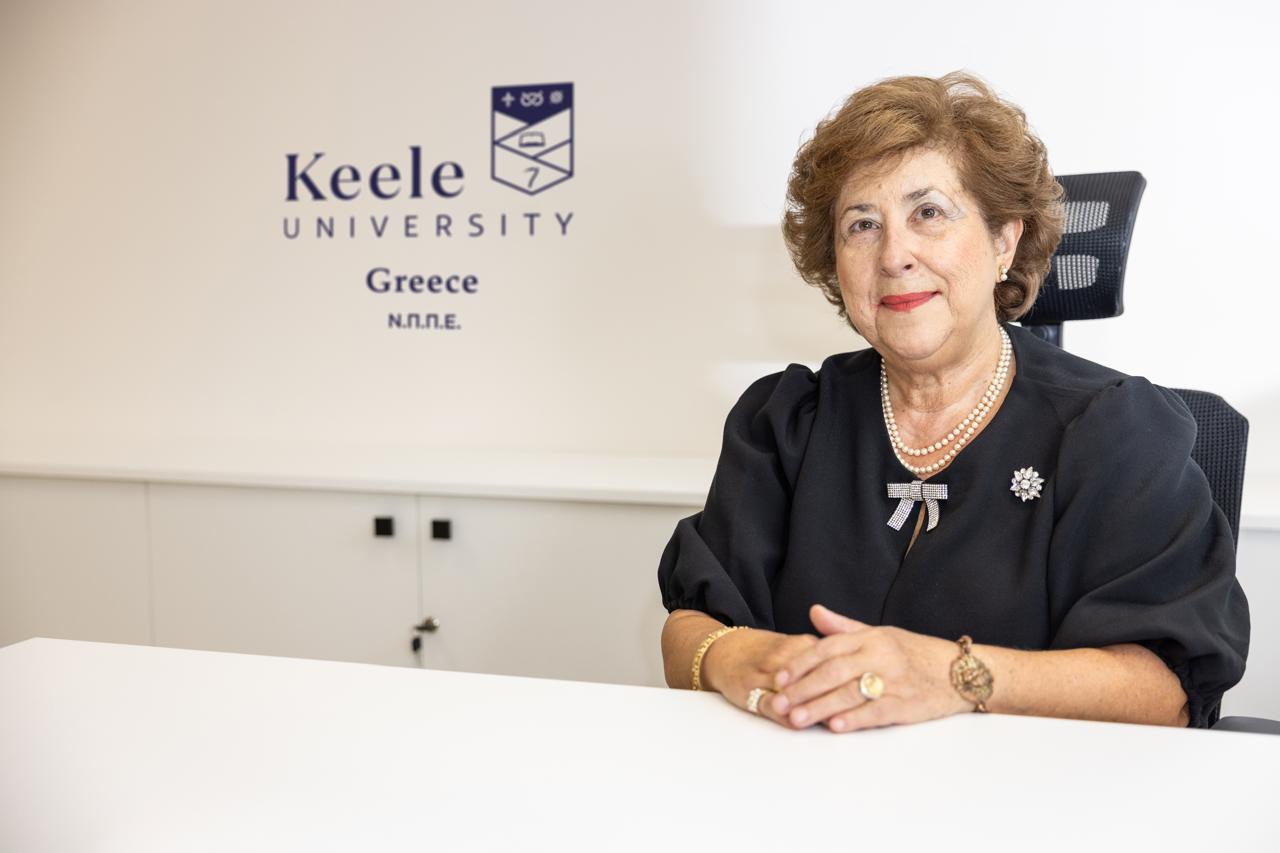
The Dean of the Faculty of Humanities and Social Sciences of Keele University Greece speaks to Parapolitika and journalist Ismini Charalambopoulou.
In an interview published on powergame.gr, Professor Ismini Kriari, Dean of the Faculty of Humanities and Social Sciences at Keele University Greece and former Vice-Chancellor of Panteion University, focuses on the need to prevent young people from leaving Greece to study abroad, as well as on Greece’s potential to evolve into an international hub for Higher Education.
Following the accreditation of the programmes in English Studies and Psychology, Professor Kriari emphasises that these developments will encourage many young people to remain in Greece for their studies. She notes that during her tenure as a member of the Board of the Hellenic National Academic Recognition Information Centre (DOATAP), responsible for the recognition of Law degrees, qualifications submitted for recognition included degrees from universities as far afield as Siberia and small towns in Sicily—often requiring extensive correspondence and verification procedures.
As she explains, Greek families demonstrate a strong commitment to supporting their children’s education, and it is preferable, in her view, for an 18-year-old to pursue undergraduate studies in their home country and then, if they wish, continue abroad for postgraduate studies. “In my opinion,” she notes, “undertaking one’s first degree abroad involves a significant emotional burden for both the family and the student. Although the student moves abroad for a positive purpose—education—they are not yet as emotionally prepared as, for example, a third-year student participating in an Erasmus programme.”
Professor Kriari stresses that the establishment of non-state universities will help retain young people in Greece and that Humanities degrees remain essential even in the modern era.
“I believe this is a gap that private universities will help to fill. Once students realise that degrees of equivalent quality are offered in Greece, many will choose to stay. Why should someone not study in their own country when they can obtain a strong degree in Greece? Public universities already enjoy an excellent reputation, and I hope that non-state universities will achieve the same standing,” she states.
Regarding the future of Humanities studies, Professor Kriari explains that Keele University Greece currently offers two programmes within the School of Humanities and Social Sciences: English Literature and Psychology with a focus on Neuroscience.
English Literature, she notes, involves an exceptionally high level of English language proficiency—not only for those pursuing teaching careers, but also for translators and professionals seeking employment in roles that require advanced English skills, such as cultural institutions, commercial organisations, polling companies, and positions that require engagement with English-language academic literature.
“There is virtually no sector today that does not require English-speaking staff,” she adds.
She emphasises that the programme’s prospects are very strong, as it combines language mastery with engagement in classical texts that may be adapted for film or theatre, while English also remains indispensable in advertising and communication.
The Psychology programme is also a strong point of attraction. Drawing on her extensive experience at Panteion University, Professor Kriari describes psychology as a dynamic discipline with strong social relevance.
“We live in an era where many people are searching for who they are and what they are,” she observes, noting that this drives many young people to study Psychology – a field that also offers a wide range of professional opportunities. Graduates may establish private practices or work in correctional services, school psychology, gynaecological units, rehabilitation centres, and other specialised settings.
“Our aim is to further develop the department by integrating additional academic units and to establish the distinct academic identity of our University,” Professor Kriari explains. She also highlights that many members of the teaching staff are graduates of Panteion University at either undergraduate or postgraduate level, which, as she notes, “provides a sense of reassurance and continuity.”
Finally, Professor Kriari underlines that Greece has the potential to become an international centre for Higher Education, with Keele University playing an important role by attracting students from a wide range of countries. She stresses, however, that a number of practical issues must be addressed for international students, including accommodation, healthcare provision, and student welfare services.